

Employer Details
|
Employer: |
Pacific Blue Cross |
|
Address: |
4250 Canada Way, Burnaby BC V5G 4W6 |
|
Time Period: |
January 1, 2025 to December 31, 2025 |
|
NAICS Code: |
52 – Finance and Insurance |
|
Number of Employees: |
839 - (300 to 999 employees) |
About Pacific Blue Cross’ Workforce
As British Columbia’s (BC) largest and only not-for-profit health benefits society, Pacific Blue Cross (PBC) remains committed to providing health benefits that deliver on our mission – to improve health and wellbeing for British Columbians. Together with our Board of Directors and CUPE 1816, the Union representing roughly three-quarters of our workforce, PBC provides comprehensive health, dental, life, disability and travel coverage to 1 in 3 British Columbians through group and individual plans. Beyond health benefits, PBC actively supports charitable organizations across the province that are working to improve health outcomes and build healthier communities.
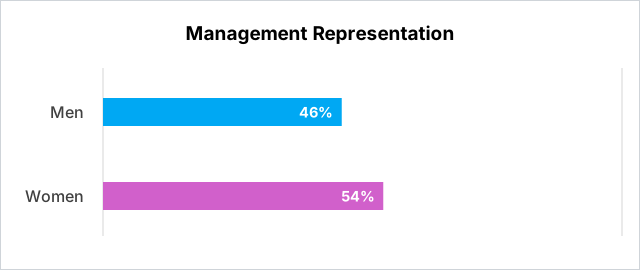
In this reporting period, our workforce consisted of 839 employees and spans a wide range of disciplines. Women represent 65% of our workforce (543 employees), while men make up the remaining 35% (296 employees) and together they are essential to our continued success. All employees receive equitable pay for equal work, regardless of gender. However, women are overrepresented in the Customer Experience and Claims departments but underrepresented in the higher paid technical jobs such as Information Technology resulting in a pay difference between men and women. Women – including our President and Chief Executive Officer (CEO) – held 54% of all leadership roles, while men accounted for 46% of management positions.
Commitment to Pay Equity
All union employees receive equal pay for comparable work. Each bargaining unit job is evaluated and assigned a job grade, with compensation determined by the wage rates outlined in the Collective Agreement.
Compensation for management and exempt employees is governed by policies and procedures designed to ensure objective, fair and equitable pay for comparable work considering knowledge, skills, abilities and working conditions, regardless of protected characteristics such as sex, race, ethnicity or gender. These policies also guide our hiring, retention and promotion processes, reinforcing our commitment to selecting the most qualified candidates for each position.
Advancing Women’s Health and Workplace Equity
Building on the findings of the 2024 HER-BC (Health and Economics Research on Midlife Women in British Columbia) study, Pacific Blue Cross continued advancing women’s health equity in 2025, recognizing the relationship between health, workforce participation and career opportunities.
The research highlighted several important workplace considerations:
- 32% of respondents reported that menopause symptoms affected their jobs in some way.
- 17.2% reported reducing their working hours because of menopause symptoms.
- 9.4% reported turning down a promotion or career advancement opportunity because of symptoms.
These findings demonstrate how midlife health challenges can create barriers to workplace participation and career progression, with potential implications for earnings and long-term financial security.
Equity & Inclusion Initiatives - 2025 Targeted Health & Wellness Support
Pacific Blue Cross took further steps to address these challenges through:
- Expanded menopause support: Partnering with sanoLiving to make sanoMidLife available through PBC health plans, providing access to personalized assessments, education and virtual resources for midlife health.
- Investment in specialized care: Committing $300,000 over three years to support the Menopause + Midlife Health Program at BC Women's Hospital + Health Centre, advancing access to specialized care, education and research.
These initiatives reflect PBC's broader commitment to reducing barriers to health and wellbeing, including those that can affect women's participation in the workforce.
Organizational Equity, Diversity & Accessibility Partnerships
To ensure long-term, systemic workforce equity, Pacific Blue Cross maintains key partnerships and recognitions across diversity, equity, accessibility and workplace environment standards:
- Accessibility & Inclusion: Achieved RHF Accessibility Certification through the Rick Hansen Foundation.
- Indigenous Inclusion: Recognized as an Indigenous Works Employer of Choice.
- Diversity & Belonging Partnerships: Strong active partnerships with Pride at Work Canada, the Canadian Centre for Diversity and Inclusion (CCDI) and Open Door, Accessible Employers.
PBC encourages employees to self-identify their gender and is committed to upholding privacy and anonymity, in accordance with the Pay Transparency Act and applicable reporting guidelines. Due to data thresholds designed to protect individual privacy, information regarding our non-binary employees has not been included in the current report. We remain committed to reporting on our non-binary employee population once sufficient data is available.
Workplace Excellence & Facilities:
PBC received The Outstanding Building of the Year (TOBY) Award, recognizing excellence in building management, sustainability, safety and operational practices for Corporate Facility.
Percentage of Each Gender in Each Pay Quartile
The overall gender distribution for this reporting period is 65% women and 35% men across PBC’s employee population. As a result, women represent a larger proportion of employees within each of the hourly pay quartiles.
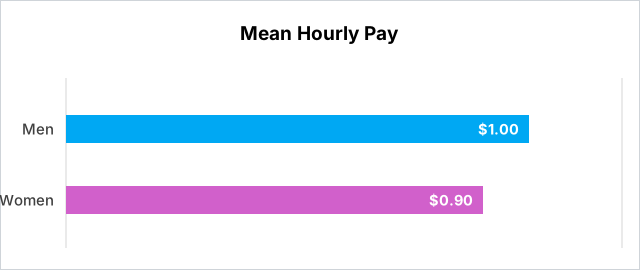
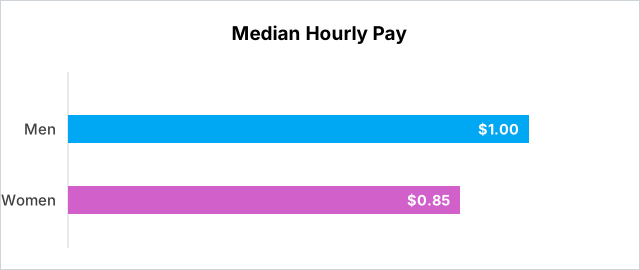
The overall pay differential between men and women does not necessarily reflect differences in pay for the same or comparable work. Rather, it is influenced by several workforce factors, including the distribution of employees across occupations and pay ranges, as well as differences in experience, qualifications, education and progression within established salary structures. Women have a higher representation in areas such as Customer Experience and Claims, which generally fall within lower pay ranges and lower representation in some higher-paid technical occupations, including Information Technology.
For Bargaining Unit positions, compensation is determined by the wage rates established in the Collective Agreement, with employees progressing through applicable wage steps. For Exempt and Management positions, salary progression occurs through PBC’s merit and other compensation practices. As employees gain experience and progress within these established compensation structures, their pay may increase accordingly.
PBC continues to support the recruitment, development and advancement of women across the organization, including opportunities for progression into higher-paid technical and leadership positions.
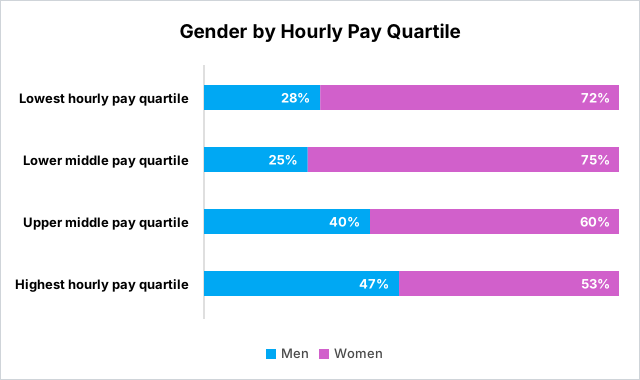
View data table: Gender by Hourly Pay Quartile
| Hourly Pay Quartile | Men | Women |
|---|---|---|
| Lowest | 28% | 72% |
| Lower middle | 25% | 75% |
| Upper middle | 40% | 60% |
| Highest | 47% | 53% |
Gender Distribution in Leadership Roles
In this reporting period, women – including our President and CEO – held 54% of all leadership roles, while men accounted for 46% of management positions. PBC offers an internal 12-month program designed for emerging leaders. Selection for the program is done through applications and we ensure equitable representation.
Hourly Pay
PBC has implemented transparent pay structures to advance pay equity throughout the organization. All exempt and management roles are assigned a job grade, each with clearly defined pay ranges, ensuring that employees performing similar work receive equitable compensation regardless of gender, race, or other protected characteristics. Likewise, all union roles are classified by job grade, with wage scales negotiated and outlined in the Collective Agreement, guaranteeing equal pay for comparable work irrespective of gender, race or other protected attributes.
PBC conducts periodic job evaluations and pay scale reviews to maintain internal equity and external competitiveness.
Bonus Pay
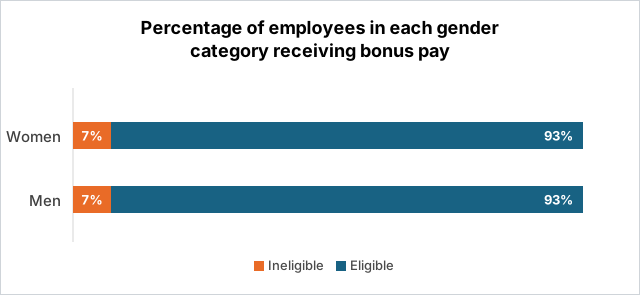
Bonus pay is one component of PBC’s total rewards package. Unionized employees are eligible for surplus sharing as outlined in the Collective Agreement, while exempt and management employees are eligible for annual bonuses determined by job grade, corporate rating and individual performance.
View data table: Bonus Pay Eligibility
| Gender | Eligible | Ineligible |
|---|---|---|
| Women | 93% | 7% |
| Men | 93% | 7% |
Employees are not eligible for a bonus if they fall into any of the following categories: temporary exempt employees, union employees on long-term disability, union employees on a casual contract, or union employees who have not completed their new hire probation by the surplus sharing payment date.
However, employees on leave, who worked during the calendar year, will receive their bonus payment upon returning from leave.
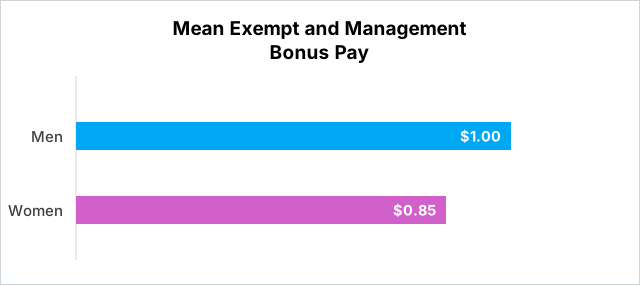
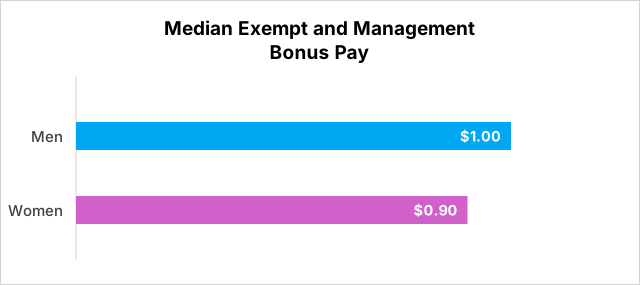
Exempt and management employees are eligible for an annual bonus in accordance with their job grade, and which depends on individual performance and corporate performance.
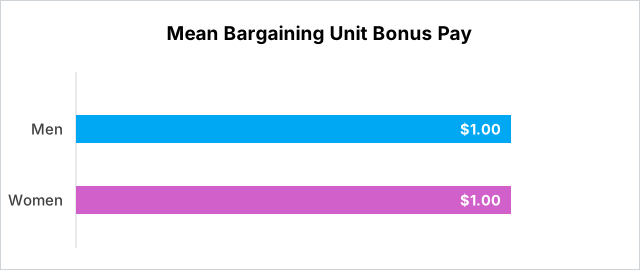
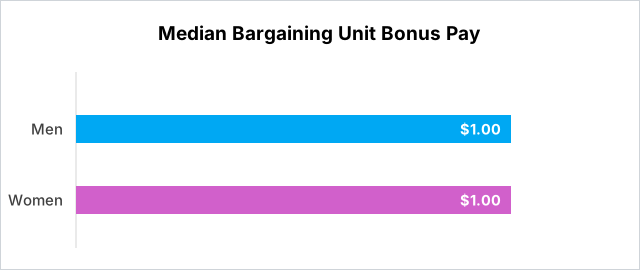
Unionized employees participate in a surplus sharing provision outlined in the Collective Agreement.
Overtime Pay
Overtime hours and pay are available exclusively to bargaining unit employees. As outlined in the Collective Agreement, participation in overtime work is entirely voluntary.
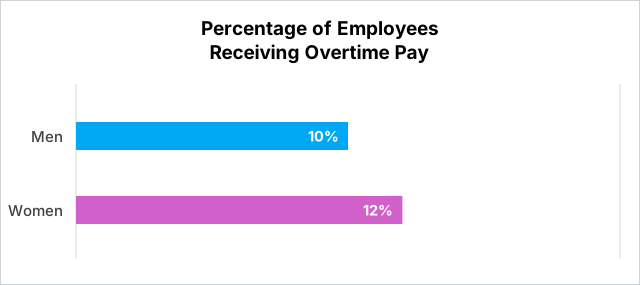
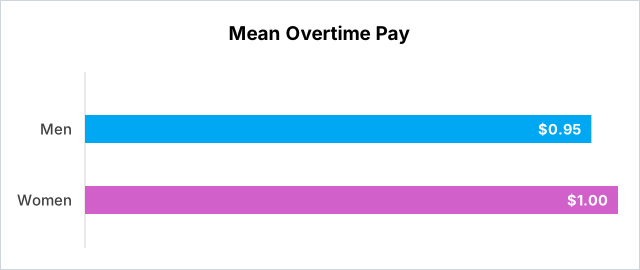
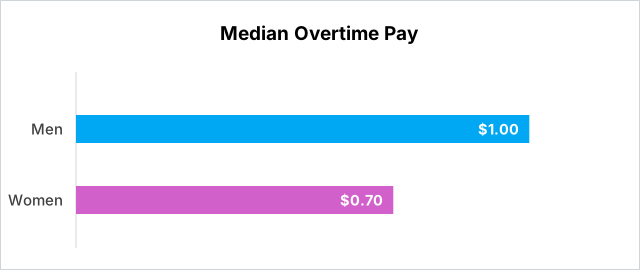
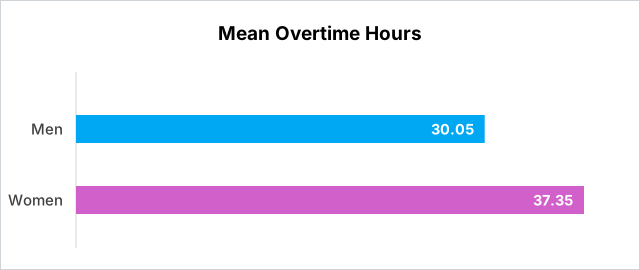
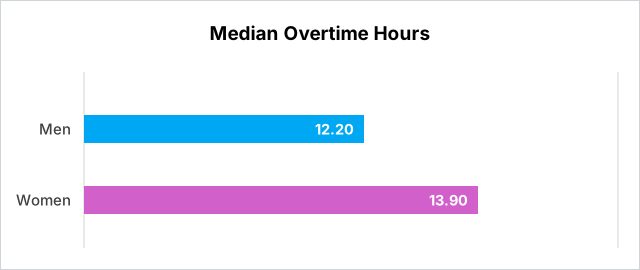
The above overtime pay and hours illustrate that women are more likely than men to volunteer for additional overtime work, leading to higher overtime earnings among female employees.